

5 Signs Your Company’s ICOFR System Is Outdated, and How to Fix It
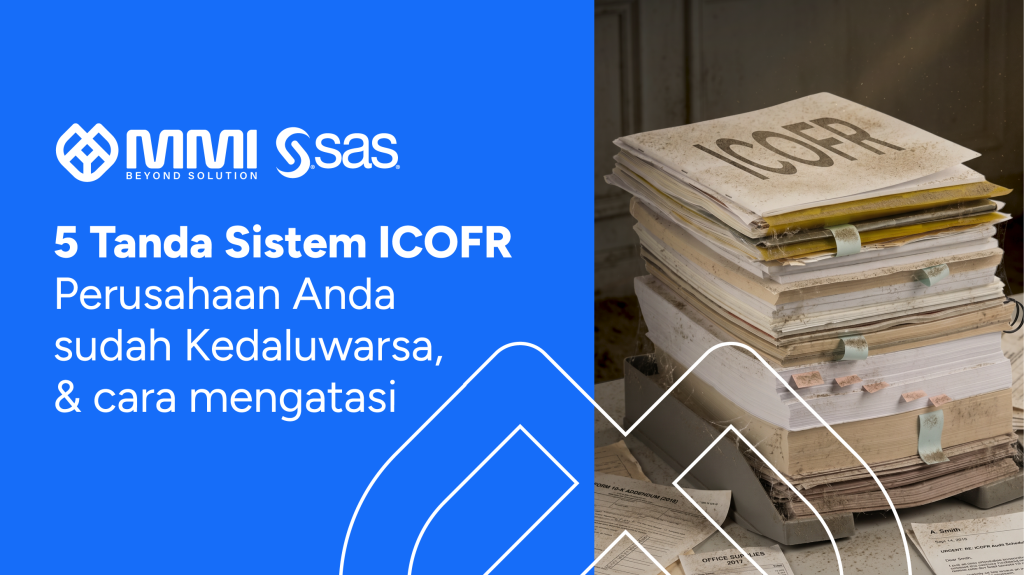
Recurring material weaknesses year after year are rarely a coincidence. More often than not, they are the primary symptom of an outdated Internal Control over Financial Reporting (ICOFR) system. At its core, ICOFR is a framework designed to guarantee the accuracy and completeness of financial statements not just an administrative compliance checklist to get through the year. When this system becomes obsolete, the risk of financial reporting failures spikes. This article highlights five signs that your ICOFR modernization is long overdue and provides a clear path forward to keep your organization accountable.
Why ICOFR Remains a Challenge for Many Companies
Regulatory bodies enforce strict guidelines regarding internal governance. Under capital market regulations such as POJK 8/POJK.04/2014 in Indonesia, public companies are required to establish and maintain an effective ICOFR framework, which is verified through annual audits.
Yet, reality on the ground often tells a different story. Many enterprise organizations still run their internal control financial reporting using manual, spreadsheet-based approaches inherited from initial implementations years ago.
Leaving these outdated practices unchecked exposes companies to severe risks:
- Material misstatements in financial reporting.
- Regulatory sanctions, warnings, and financial penalties.
- A permanent loss of investor confidence in the capital market.
Signs 1 & 2: Manual Testing and Scattered Documentation
The earliest indicators of an obsolete system usually lie within operational inefficiency and poor evidence management.
1. Control Testing is Still Performed Manually
Executing control testing manually every quarter or year drains significant time from finance and internal audit teams. Copying data, physically matching documents, and conducting manual sign-offs leave teams with zero bandwidth for strategic analysis.
2. Control Evidence is Scattered Across Multiple Files
When evidence is buried across localized desktop folders, emails, and chat applications, external auditors face major hurdles tracing the audit trail. This triggers an extended audit timeline and heightens the risk of a material weakness audit finding.
Practical Self-Check Indicator: Measure how long it takes your team to gather and present complete documentation when an external auditor makes a surprise sample request. If it takes days just to locate a single item, your system is outdated.
Explore our related info: Instagram Carousel: 5 Signs of Outdated ICOFR
Signs 3, 4, & 5: Zero Visibility to Sluggish Remediation
The next three warning signs involve how responsively your system reacts to shifts in the business landscape.
3. Lack of Real-Time Visibility into Control Status
Without a centralized dashboard, management operates blindly. Control gaps or failures are typically caught months later during interim or year-end audits, forcing the company into a reactive, firefighting mode.
4. Control Matrices Do Not Automatically Update
As business workflows or IT architecture evolve, the Risk Control Matrix (RCM) frequently gets left behind. This creates a dangerous disconnect between what is documented on paper and what actually happens on the ground.
5. Slow Remediation of Found Issues
The most common criticism from external auditors and audit committees is the recurrence of the exact same audit findings year after year. Sluggish remediation indicates a lack of automated tracking that holds control owners accountable.
The Path Toward ICOFR Modernization
To break free from the limitations of an obsolete framework, companies must fundamentally restructure their approach through two core initiatives:
- Adopt Continuous Control Monitoring: Pivot from transactional “snapshot” annual testing to an ongoing monitoring model (continuous control monitoring). Automation technology can trigger early warning alerts the moment a control anomaly occurs.
- Establish Centralized Documentation: Build a single, cloud-based source of truth accessible to finance, internal audit, and external auditors alike. This eliminates the frantic scramble for physical or scattered digital documents.
Modernizing your framework yields long-term dividends: significantly shorter remediation cycles, cleaner audit opinions, and stronger investor trust anchored by robust corporate governance.
Conclusion
A mature ICOFR framework is no longer just an administrative box to check for compliance purposes; it is a strategic investment that protects your company’s credibility and market value.
Want to know where your company stands on the ICOFR maturity scale? Schedule a complimentary ICOFR Health Check with our expert team at [Health Check Registration Link].